
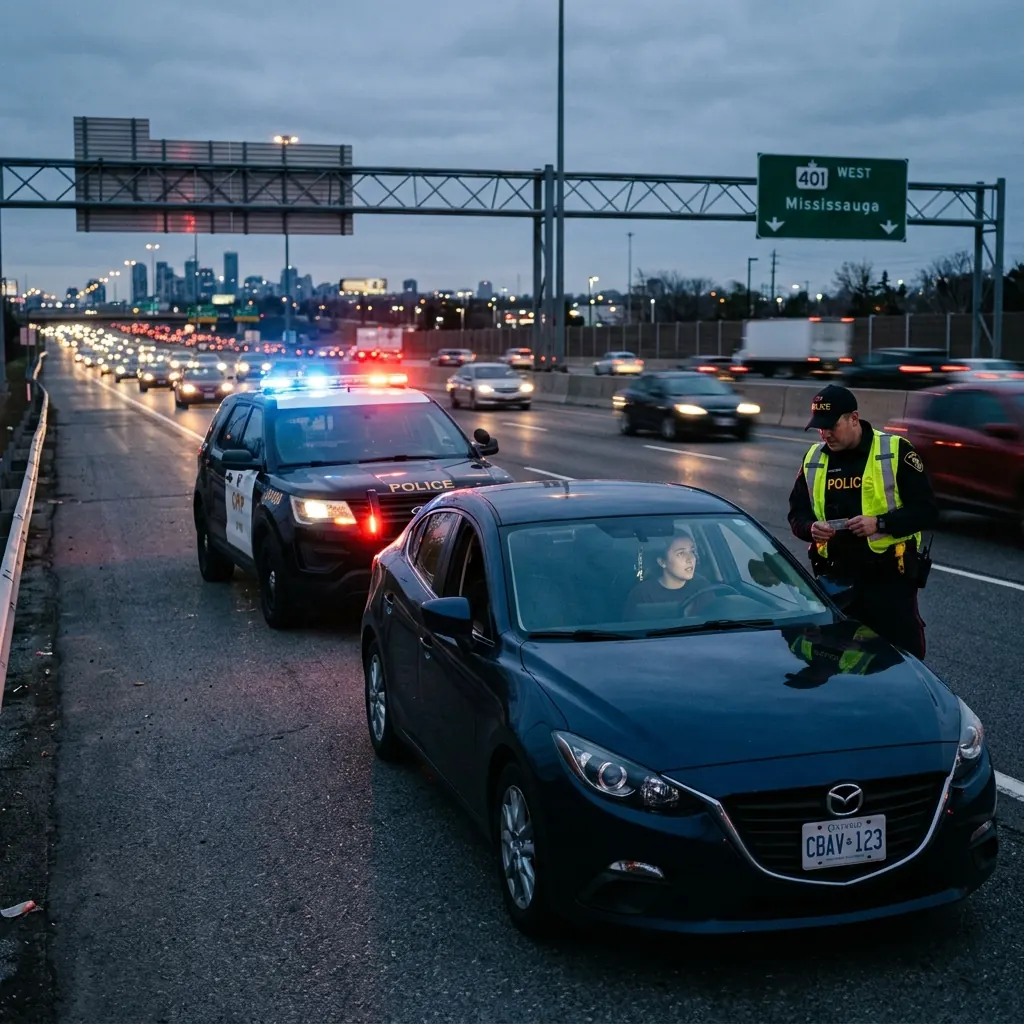
A rolling stop at a stop sign costs $110-$180 and adds 3 demerit points. What Ontario law requires, why these tickets are contestable, and your options.
What the law actually requires
Section 136 of the Highway Traffic Act requires a driver to come to a complete stop — wheels fully stationary — before proceeding through a stop sign, and to yield to any traffic or pedestrians with the right of way. A slow roll through the intersection, even at low speed, does not satisfy the legal requirement.
What it costs you
The set fine is $110. Once the provincial victim surcharge and costs are added, the total payable printed on the ticket is about $180. If the sign sits in a posted community safety zone, the set fine is doubled to $220 before those additions.
On top of the money, a conviction adds 3 demerit points and typically raises insurance premiums by 10–15% for 3 years.
| Charge | HTA section | Demerit points | Fine range |
|---|---|---|---|
| Fail to obey a stop sign | 136(1) | 3 | $110 – $180 |
| Fail to stop at a red light | 144(18) | 3 | $260 – $325 |
| Turn not in safety | 142(1) | 2 | $110 – $180 |
| Unsafe start from a stopped position | 182(2) | 2 | $110 – $180 |
Why these tickets are often defensible
Stop sign matters frequently come down to the officer's vantage point and reaction time — whether they had a clear, unobstructed view of your wheels actually stopping, and whether their notes were written with enough precision to survive disclosure review. We request the full officer notes and, where available, any dashcam or intersection camera footage before advising on your best path forward.
Is a rolling stop a separate offence in Ontario?
There is no “rolling stop” charge in Ontario's Highway Traffic Act. A rolling stop is prosecuted as failing to obey a stop sign under HTA 136(1). The phrase appears in police notes and in court because it describes what the officer says they saw — wheels still turning as the vehicle crossed the stop line — but the charge printed on the ticket reads “fail to obey stop sign.”
That matters because the ticket does not allege that you ignored the sign. It alleges that you did not stop completely. The whole case therefore turns on one factual question, which is also the easiest thing to test in disclosure.
What the officer has to prove
A stop sign conviction needs all four of these elements. If any one is missing, or the evidence on it is thin, the charge is beatable.
- A stop sign was facing you at that location and was visible and properly posted.
- You were the driver of the vehicle at the time.
- Your wheels did not come to a complete stop before the stop line or crosswalk.
- The officer had a clear, unobstructed view of your wheels at the moment you passed the sign.
How to fight a stop sign ticket in Ontario
You have 15 days from the date of the offence to respond. If you want to contest it, do not pay — paying is a guilty plea and the 3 points and insurance hit follow automatically.
The realistic paths are an early resolution meeting with the prosecutor, or a trial. Either way the first step is disclosure: the officer's notes, the sign's location and by-law, and any video. Cases are frequently resolved by reduction to a lesser offence with no demerit points, and occasionally by withdrawal when the notes do not establish that the officer could actually see the wheels.
What 3 demerit points means for a novice driver
Three points is not a minor number for a G1 or G2 driver. Novice drivers get a warning letter at 2 points, must attend an interview at 6, and face a licence suspension at 9. A single stop sign conviction therefore crosses the warning threshold immediately and puts you halfway to the interview.
For a full G licence the same conviction is 3 points against the 6-point warning letter and 15-point suspension threshold, but the insurance effect — roughly 10–15% for 3 years — usually costs more than the ticket itself.
Sources & official references
This guide summarises Ontario law and court practice. The primary sources are:
- Highway Traffic Act, R.S.O. 1990, c. H.8 (Ontario)
- Provincial Offences Act, R.S.O. 1990, c. P.33 (Ontario)
- Criminal Code of Canada (Justice Laws)
- Law Society of Ontario — find a licensed lawyer or paralegal
Last reviewed October 20, 2026 by Mukhtar Ahmad, P1 Paralegal (LSO #P06498). General information only — not legal advice for your specific matter.
Want our guides to show up first in Google?
Add Bridge Legal Services as a preferred source. Once you do, our Ontario traffic-ticket guidance is more likely to be highlighted in Top Stories and in Google's AI answers when you ask about tickets, demerit points or fighting a charge.